
Beyond Bird Watching
Considering What I Don't Know About Birds

Dear Friends,
Here’s a funny little thing I’m known to tell people: despite the nickname, I know very little about birds.
Maybe I’m just still a few years shy of the evolution toward bird-watching that seems to have become a middle-age right of passage or maybe I’m just not outdoorsy enough, but I just can’t identify very many birds or tell you where they live or what they sound like. I can spot more than I once could, but it’s the low-hanging fruit of birds: crows and ravens, red-tailed hawks, mallard ducks, great blue herons, and so forth. It doesn’t help being extremely nearsighted, making it extra hard to get a good look at birds up in a tree or on a telephone line.
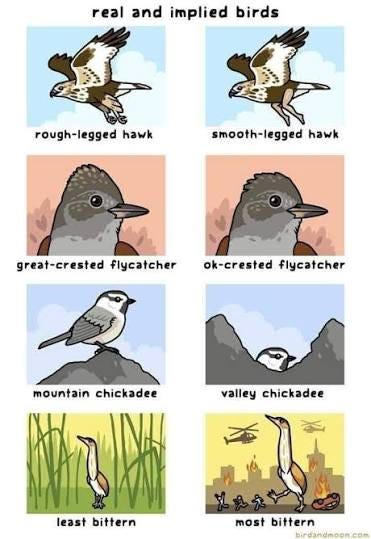
(I would, however, love to know what bird outside my house sounds like an electronic alarm, though. Because, wow, that particular bird has been making me a little bonkers these last few weeks. I keep worrying that the refrigerator has been left open or a smoke alarm is chirping in the distance.)
My name may be Bird, but that’s about where my knowledge stops. Luckily, I’m not in charge of anything bird-related.
Consider The Sparrows
(Want the “I don’t come to bring peace but a sword” take? You can find my reflections on that part of the Gospel here - from 2020 - and a balance between the sword and the birds here from 2023.)
In this Sunday’s lectionary, we encounter a God who, unlike me, knows every creature intimately. As St. Matthew recalls Jesus’s teachings:
Are not two sparrows sold for a penny? Yet not one of them will fall to the ground apart from your Father. And even the hairs of your head are all counted. So do not be afraid; you are of more value than many sparrows. (Matthew 10:29-31)
A parallel to “Consider the birds of the air” from a few chapters before (Matthew 6:26), this passage calls us into God’s all-encompassing love, the way nothing is beyond God’s notice. The God that notices the fallen sparrow cannot be a watchmaker God who sets the course and lets it go, but a close, personal God, the God of omnipresence who, grants us their own image but does not forget the rest of what God calls good.
That is one of the first things I notice about this text – the personal nature of God not just to us but to all creation – and it helpfully calls back to the passage from Genesis regarding the disposition of Hagar and her son Ishmael, a part of the Great Family story I’ve been thinking about more closely recently. That’s because the revised Great Family story from Godly Play draws our attention to the parts of that lesson that are attractive. We confront Abraham’s keeping slaves and his attempt to sidestep God’s covenant with him by having a child with Hagar. But God does not forget Hagar even when she is cast out – not even in the slightest.
Even to Abraham, God says, “As for the son of the slave woman, I will make a nation of him also, because he is your offspring.” It seems to me it would be one thing to catch up Hagar in this moment when she is cast out, but to remind Abraham that this promise is serious is remarkable. Not borne by Sarah, Ishmael will still share in the covenant. Thinking in the context of the time, there is something in this reassurance that makes it not unlike saying that God it attentive even to the sparrow. The slave and her child cannot be forgotten. Nothing escapes God’s loving eyes or hand, as God makes a spring appear from the earth, rescuing these beloved children in their deepest despair.
Try A Deep Dive
I am a “big picture” thinker about teaching the Bible to children. Theologically and pedagogically, Godly Play has formed me to think about what the collection of stories we tell – and the way we tell them – work together to teach children about God, much more than what any singular story does.
The singular model is what my own childhood makes me think of. I was often meant to know scripture plot lines, rather than being meant to know God. That being said, sometimes you need something different and all the right pieces exist! So here are a few pieces for the Gospel passage that wouldn’t normally make the programming cut for me. It’s also aguably an especially good combo for summer.
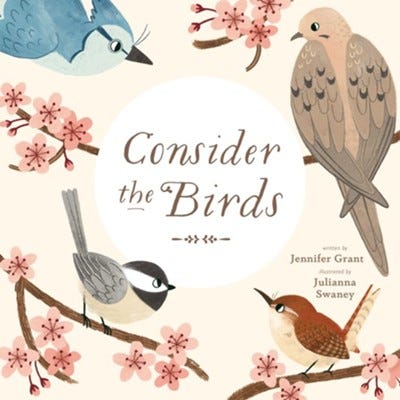
First, for the youngest, we’ve got Jennifer Grant’s Consider the Birds, illustrated by Julianna Swaney. While designed as a counting book, it’s also a text attuned to God’s careful creation of all these distinct creatures. It’s not just sparrows or chickadees but doves, cardinals, and more. Each draws God’s tender eye to it.
Have older kids? With a little help from Debbie Blue’s Consider the Birds and Kevin Burrell’s Considering Sparrows, consider how God created the birds of the Bible as teachers to us. I wonder what birds are native to your region and what their traits can teach you?
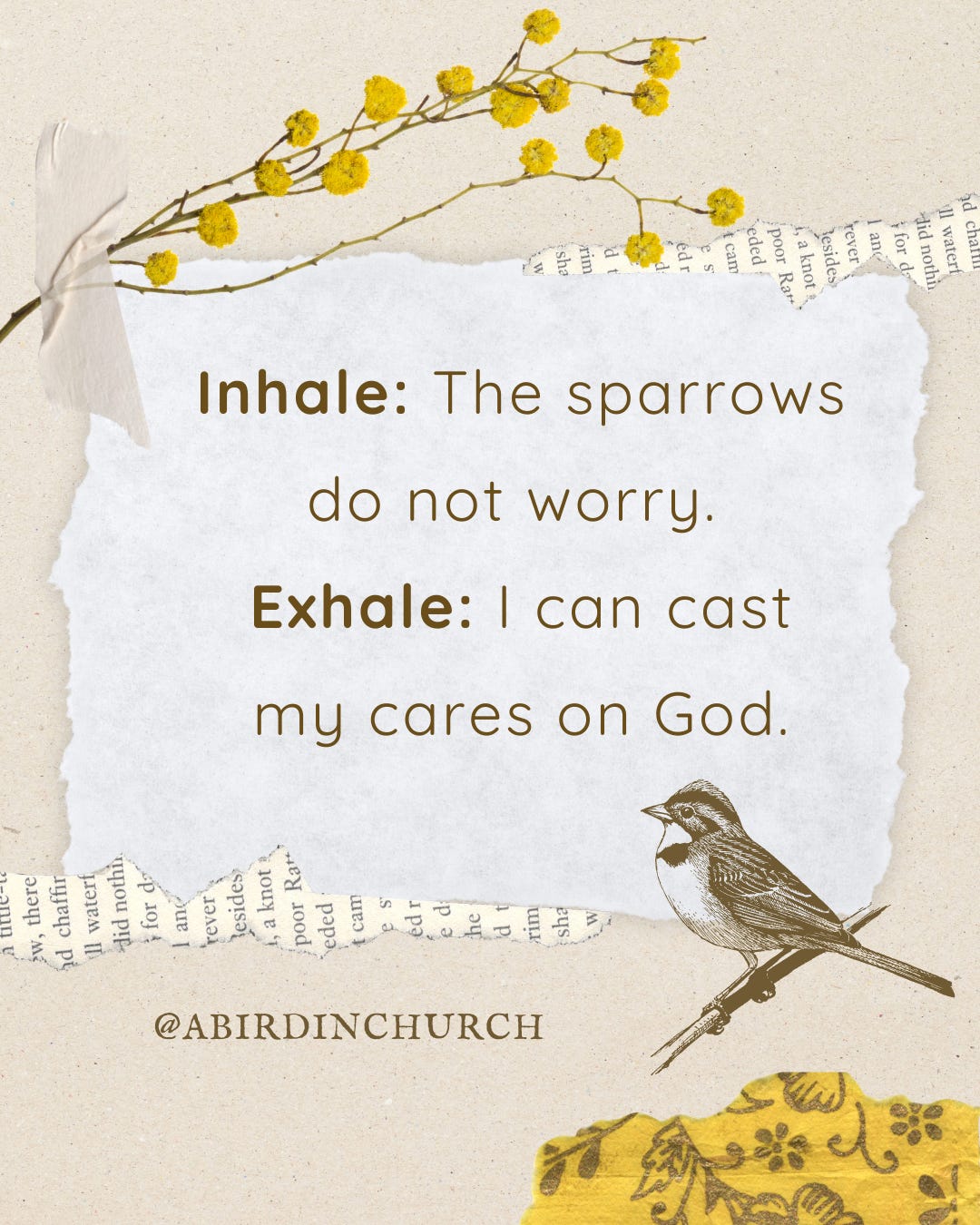
Both of the passages about God’s attention to creatures as lowly as birds from Matthew that I mention above offer us the ability to pray scripture that grounds us in love and security rather than anxiety. Here is a breath prayer you can try - or write your own!
Perhaps my favorite resource for connecting with this text is Ellie Holcomb’s song, “Do Not Worry,” which is one I sing a lot.
So just look around you, try to listen to the song creation sings - and don’t you worry cause you’re in the hands of the God who made everything.
Other ways you might come close to God through this text:
Learn about what kinds of seeds and plants are most attractive to the birds in your area and make your own bird feeders. The birds may not be worrying about their meals, but that doesn’t mean you can’t tend to their environment!
Tween/teen idea: Use your new info on birds to make a “Which Bible Bird Are You?” quiz. (Who doesn’t love a magazine quiz?!)
Make a “self-portrait’ as bird based on the ones whose gifts you think you share. Maybe you have wings the same color as a grackle but feet for paddling confidently through rough waters like a duck or a swan.
Visit a bird sanctuary. Consider how we name this particular kind of place – set apart, the same language we use for our worship spaces. What makes a place sacred for birds? How might birds offer praise to God?
Resource Round-Up
Program Leadership – I know we don’t like Amazon, but we do love maximizing our program budgets and Amazon Prime “Day” is June 23-26 with some early sales happening now. I often find this is a good time to stock up on my favorite sensory brands and tools, art supplies and storage containers, and even books. Maybe you need floral foam for Advent wreaths - you might just catch a sale now even though its months away!
Mark your calendars and get excited because the Forma 2027 Conference theme was just announced! I’m so looking forward to once again be co-hosting the gathering in Province 1 as we reflect together on the idea of Sanctified Imagination.
Looking for a more pragmatic book of grief for children to add to your bookshelf? I recently got to review Korie Leigh’s What Does Grief Feel Like, which has actually been out since 2023. This book introduces the concept of grief and then describes the ways people might respond to it, ways a child can attribute different characteristics to it (size, color, etc.), how communities remember people they have lost, and other useful insights – all in kid-friendly language and imagery. This isn’t a book that tells a story so much as it is a book that gives children the language and concepts they need to tell their own grief story, which is so essential.
Have you ever used Rob James’s Fifty New Testament Stories for Storytellers? I hadn’t ever run into it (despite it being published by CPI/Morehouse), but the sequel - Fifty Old Testament Stories for Storytellers is forthcoming in September. I appreciate that from the outset in his introduction, James states that he has made intentional choices re: places where he points to Jesus in these texts, while also stating plainly that the “Old” of OT is an intentional choice (as opposed to Hebrew scriptures/Bible) meant to describe these scriptures as “venerable.”
Overall, I deeply enjoy the way this book intentionally teaches storytelling; James encourages storytellers to add to repetition where the listeners enjoy it, to create the stories collaboratively, to make choices that fit your context. I think he also makes some great choices around the kinds of funny details that children like to play with. For example, in the second creation, he describes the snake’s legs retracting as he slithers off. He also makes some really interesting linguistic choices, describing Noah’s time in the ark as “lockdown” or saying that Adam and Eve’s hearts would never be able to rest in the garden again after they ate the forbidden fruit. And I LOVE how he highlights how annoying Joseph’s older brothers found him.
The art is kind of a bummer - it comes across as less stylized than just not very good – but if you’re looking to approach storytelling with children or even multigenerational audiences, this book could be a great tool for honing your own approach.
I’ll be back on 6/30 after I undertake some professional development time. Until then, consider the birds…
Peace,
Bird
Thank you for another round of terrific ideas. We are observing the birds differently in eastern Washington today! 💗