
Naming Our Light
Then Sharing It With Others

Dear Friends,
Hello from inside the fog of exhaustion! I am back from the Forma conference in Denver where, relative to my home base (which is covered under about 2 feet of snow) was balmy and clear, about 40 degrees. I didn’t take a ton of pictures (check-in on the visuals at my IG) because I was so busy being with my friends and colleagues, but St. John’s Cathedral is beautiful and a lot of good work was accomplished.
And now, back to the snow-bound north. Back to my circles and calendars and all the things that got left behind on my screens this past week. At least we’re still in the “banger” lectionary selections!
Yep: light of the world/salt of the earth AND “Is not this the fast that I choose: to loose the bonds of injustice, to undo the thongs of the yoke, to let the oppressed go free, and to break every yoke?” (Also a solid Psalm and Epistle.) We’re really in the groove in these Sundays after Epiphany. God’s getting us sorted – and doing so for such a time as this.
Contemporary Commandments
“What is the most important commandment?”
This is the question Jesus is asked before he launches into his telling of the Parable of the Good Samaritan. What is it, the man asks, that we are meant to do? And the answer is, “To love the Lord your God with all your mind and with all your heart and with all your soul and to love your neighbor as yourself.” This story is a reminder of what I like to think of as The Law 3.0.
First, the early Jewish people are offered the Laws set out in Leviticus (1.0) - all 613 of them. These are not and have never been our laws as Christians, but the 10 commandments (2.0) that come after are ours - and then Jesus’s distillation in the Gospels is our final iteration. And so, when Jesus says in the Gospels that to be counted great in the Kingdom of Heaven, we must keep those commandments and teach others the same, love – of God and neighbor – is that law.
That’s the whole thing. But how will we each do it?

Jesus offers this teaching, that we must live the commandments and share them with others, after his light of the world/salt of the earth bit and I find myself considering how we might ground ourselves in such an identity as families and communities – and I have a few thoughts.
Be The Light
As I sit here scheming about ways to talk about and practice our faith, I’m starting to think we need something like a “Christian household starter kit” that goes beyond a cross, an advent wreath and nativity, perhaps some liturgically-colored cloths. Here’s what you’ll need for this first activity, which draws heavily on the words and movements of the Godly Play baptism lesson:
Materials:
matches
a white pillar candle
a bowl of sand
a lot of tall skinny taper candles, any colors
Opening: Set out the white candle and begin with what I refer to as the classic ‘Jesus monologue.'
There once was someone who did such wonderful things and said such amazing things that people began to follow him. And when people asked him who he was, he said [strike match, light candle] ‘I am the light of the world.’
But Jesus said this about other people, too. Do you know who?
Jesus said that WE are the light of the world - you and me – and that we need to share our light by loving others. But how might we do that?
Invite everyone involved in this activity to name ways they can show love/kindness to others. For each, invite them or help them to light a taper candle and set it in the bowl of sand. Watch the light multiply.
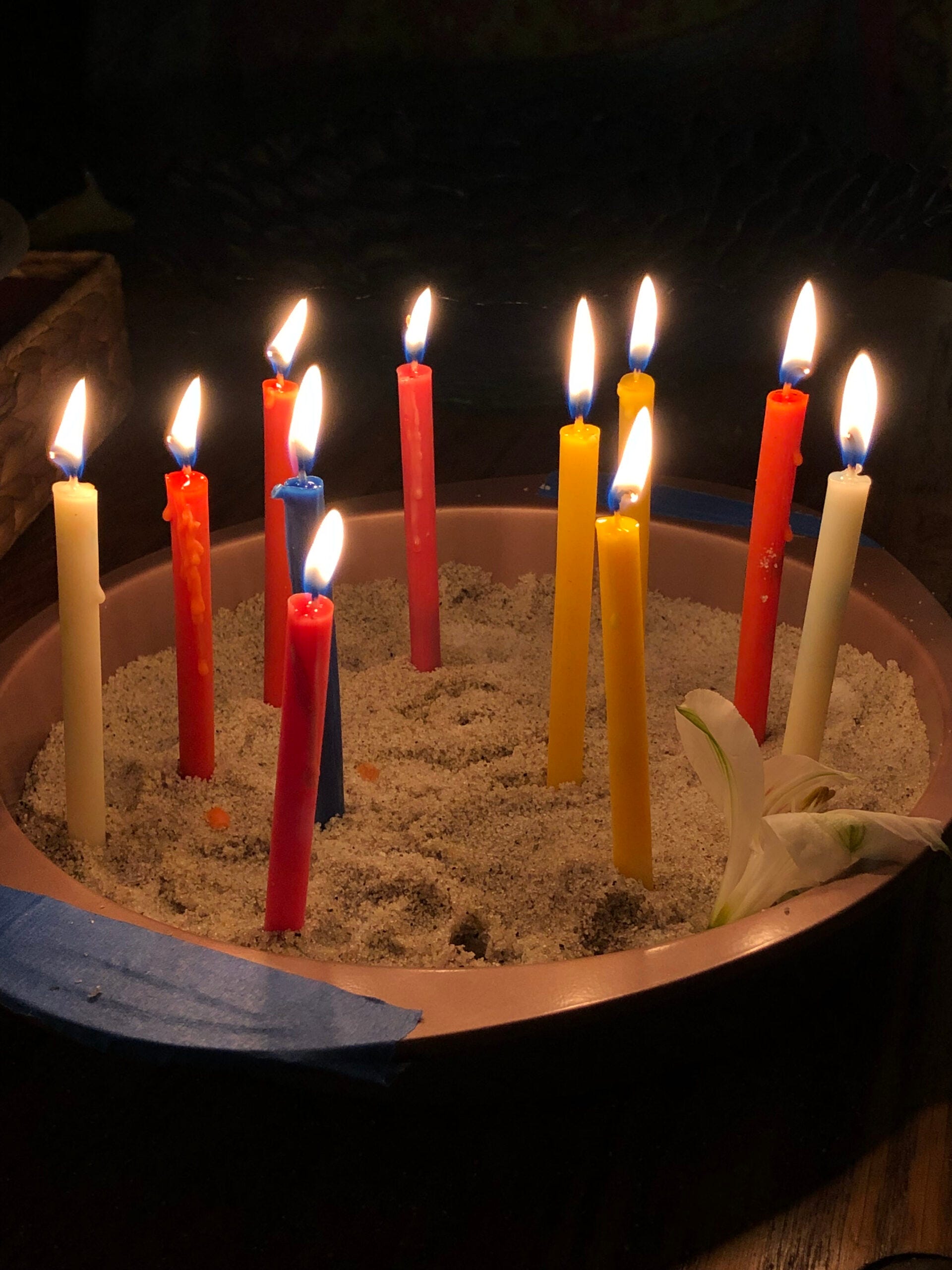
When you reach a natural end to this activity, you might enjoy the light while singing “This Little Light of Mine” or another appropriate song (depending on the age group, etc.) such as Hide Not Your Light.
Close in prayer, such as:
Lord Jesus, you are the light of the world, and you share that light with us. Help us to spread your light to everyone we meet as we live with love and kindness, never hiding our light. In your name we pray, Amen.
Change the lights together. If your family regularly uses candles as decor, you might use each taper to light another candle around the house, spreading the light, before you blow out the tapers from the activity.
Stay Salty
Being light is conceptually a lot easier than staying salty. That verse is a little trickier! That being said, if you’ve never done salt painting projects, there are fun entry points that can be adapted to different age groups.
The most popular approach to salt painting is to lay down glue in various designs and then cover the glue with salt and painting it with liquid watercolors – the salt will take up the color. But, you can also use salt to create a sort of starburst effect by adding it to wet watercolor paintings. Experiment! See what happens! What both demonstrate is that salt can change things. The glue won’t take up color and so paint would just pool around it, while the salt and paint interact in interesting ways.
Younger children and youth might use salt painting techniques to make hearts or friendly messages to hang in windows or cards to thank people in the community. Older youth might use these techniques for more conventional protest signs to hang up or share, connecting our identity as being salt for Christ to being in alliance with our neighbors, breaking the yoke of oppression. See the resource below about lament – you’ll likely find other ways to use these salt art techniques. I’m getting real “ICE Out” salt art sign vibes right now.
Resource Round-Up
I went to the amazing Valerie Grissom’s workshop on hands on practices for lament with children and youth while I was at Forma and it was so wise and necessary. My project of choice: making a tangled ball of feelings with yarn. You can learn more about that project at her website here and learn how you can practice lament collectively with your community.
Most of you know by now that I’m a big Music That Makes Community fan and the community has been really moved by how much song is part of protest and community building. You can participate in training for Singing Resistance on Zoom on February 8; the Singing Resistance Songbook is here, and the toolkit is here. Follow along on the Singing Resistance IG.
Books about the importance of bread have a sort of default place in church libraries, but I’m perhaps biased toward the new picture book, Bread Is Love by Pooja Makhijani. Pooja was a mentor with a nonprofit I participated in when I was 17-18 years old and half my lifetime later, we’re still/back in touch. She’s a brilliant writer and baker and a badass single mom who undertakes fabulous projects with her daughter. Bread Is Love would make a great supplement to your shelves around eucharist and communion and community and Pooja was featured on KidLit Love this week on the topic of family rituals.
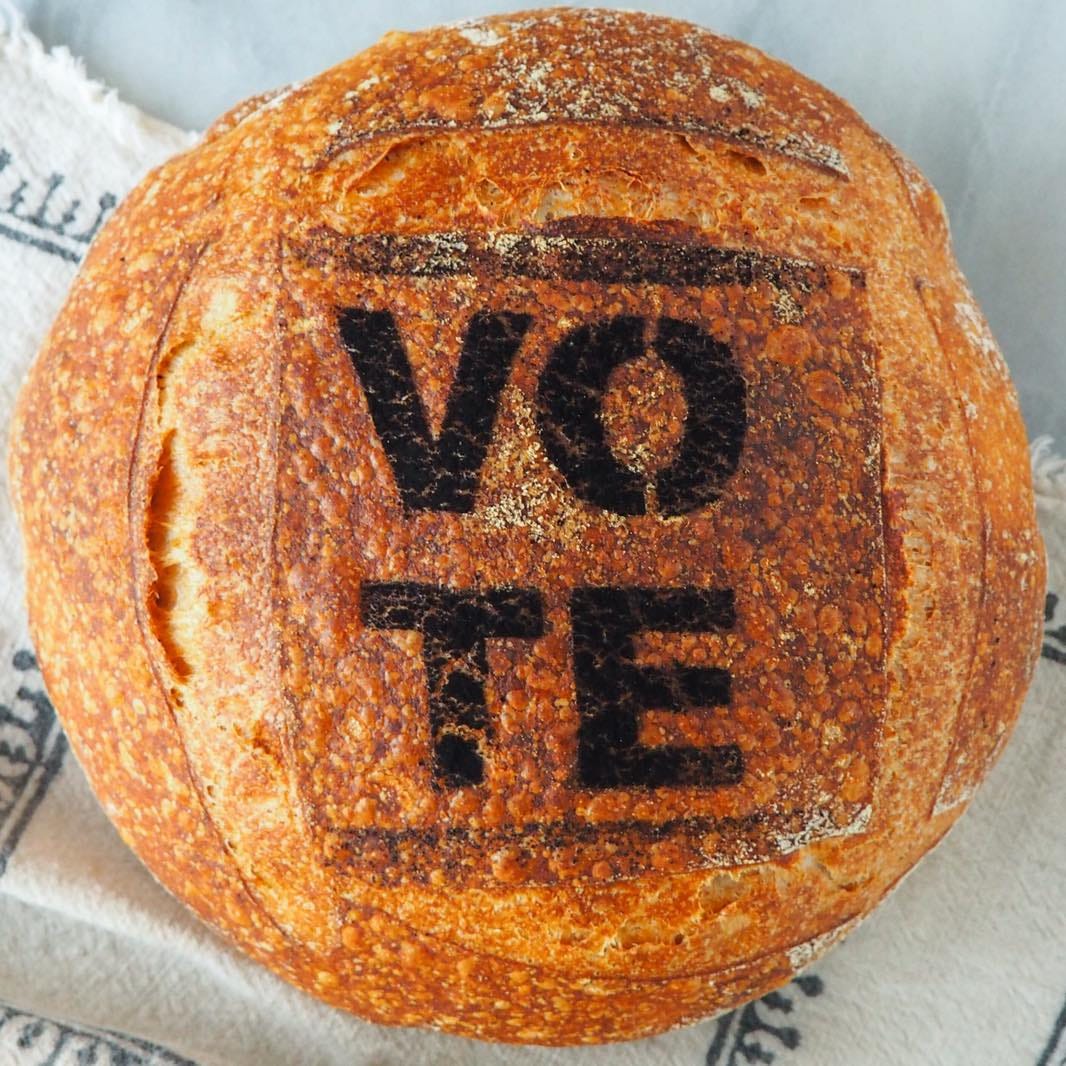
Yes, Pooja actually baked this gorgeous loaf. We talk a lot about being intentionally intergenerational in the church, but it isn’t something that comes easily. This 2023 article from The Atlantic came back across my feed this past week, addressing the value of having friends in different ages and stages of life. Our culture makes this complicated – we often worry about the potential implications of power in such relationships today – but there really is plenty of room for these relationships to be healthy when developed around real shared interests and supportive communities.
InterVarsity Press is hosting an important pair of conversations on the evenings of February 3 and February 10 at 7pm CT. The first will focus on Understanding Christian Nationalism in the United States, while the second is designed to help us address this topic with our families and communities. You can learn more and register here.
And now, for a little focus on Lent:
Godly Play returns with seasonal storytelling circles! Get ready for Lent in this beloved circle with weekly Tuesday stories. You can learn more and register here.
Looking for something really easy but embodied to do this Lent? I’m loving this little practice suggestion from Courtney Ellis, which she has called #ABirdFromTheLord. What does it involve? Sitting outside (or near a window in bad weather) for 10 minutes and watching for birds. It’s a practice of patience and noticing. It’s in keeping with our ongoing focus on attention as Ellis says, “Attentiveness is, in itself, a form of prayer.”
Lent Madness will be back this year, as usual, and I will be back to work on trading cards, so stay tuned! My plan is to run a children’s bracket against an adult bracket and we’ll see who comes closer to the main outcome!
Glenys Nellist’s Twas the Season of Lent is on a pretty steep sale right now if you don’t have a copy yet, as well as it’s companion, Twas the Morning of Easter, which means its the perfect time to pick up a copy or six.
That’s it for this week! Time to catch up on everything happening in my inbox, which is a scary reality, but we can do it.
Peace,
Bird