
On Reading Acts
Looking Back On a Very Weird Year of Church School

Dear Friends,
In many ways, I always bring my Godly Play-self to this page. It’s inevitable. Any long-time Godly Player (and all of us incorrigible trainers!) will tell you that we can’t hep but speak this language all the time. But this Sunday, as I was working my way through St. Paul’s life story in the Paul’s Travels & His Letters with a group of 5th-7th graders, I was reminded of a very particular year in my own Christian formation, an experience that held little to no resemblance to Godly Play –
In seventh grade, my class (which was taught by my dear friend’s stepfather Steve who would also lead my confirmation small group) did just one thing. We read the Book of Acts. It’s 28 chapters long, which is a pretty good length for a church school year when you factor in longer passages or school holidays. But, I’ll confess, as a 12 and 13 year old, I couldn’t really understand WHY we were doing this very particular thing.
Now, as an adult, I will tell you, Acts is an EXCELLENT book of the Bible. It’s got so much action! So many great stories! Honestly, besides maybe plowing through Jesus’s life with the efficiency of the Gospel of Mark, I think it’s probably one of the best possible choices. But going into it, I don’t remember Steve ever explaining why this was what we were doing in 7th grade. Particularly because we had never before and would not after do any full-book Bible studies in my Sunday School.

We were, of course, not reading all of Acts to get at the gloss of Paul’s life this Sunday. Rather, we were hearing the Godly Play materials, comparing Bible translations of passages, and hopping around to catch some of my favorite moments and bits of hagiography. Paul & Silas being freed from jail by that earthquake, for example, doesn’t make the Godly Play story cut, but I’ll at least be mentioning it in my own chatter about this essential figure.
As we make our way toward the end of Easter, we’ve been hearing a lot from Acts, from Stephen’s stoning a few weeks ago to the Ascension this week, and I was really enjoying lingering in key moments of this text with my tweens. Paul offers us such value in our contemporary landscape; he’s a church planter grappling with his own complicated faith as a Jewish person (and scholar) who is now also a Follower of the Way. He is a not-quite-Roman absorbed into the Roman state because of his family’s economic value. He is a person with deep yearnings and also a still-emerging identity. Paul’s life is fertile ground for youth.
Like Paul – Protected
Alongside these passages about and from Paul, this Sunday’s lectionary, as Jesus prepares to depart from his followers, offers a key reminder of the ways all of us, are held in Christ – even in those complicated, identity-shaping, cusp-of-something-new days. In this Sunday’s Gospel, Jesus prays:
I am asking on their behalf; I am not asking on behalf of the world, but on behalf of those whom you gave me, because they are yours. All mine are yours, and yours are mine; and I have been glorified in them. And now I am no longer in the world, but they are in the world, and I am coming to you. Holy Father, protect them in your name that you have given me, so that they may be one, as we are one.
Whatever it is that is happening in our individual lives and the lives of the children and young people we hold dear, help us to know that Jesus prays this over us. Jesus actively prays for our protection and unity, that we may be part of this shared glory that isn’t only to come but is also right now. This, to me, feels more profound than the parroting that Jesus loves us (which is true!) – because I think we have all been told someone loved us only for that statement to feel hollow. But this prayer, it’s intense. It’s something different.
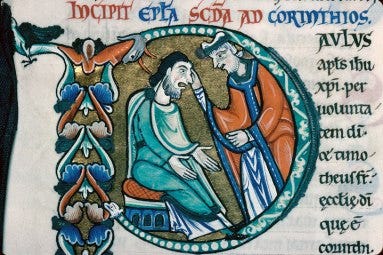
Paul and Jesus never met, of course, and the Gospels in fact postdate Paul in their composition, but in his transformation from persecutor to follower, Paul came to experience the Jesus who is the good shepherd, who comes between us and the word terrors of our world. The Jesus who prays these words in John is also the one who sends Ananias to lay hands on Paul after he is struck down on the road to Damascus. That prayer of unity and the hands of the one who acts with the care of a neighbor become one.
Of course, as we approach Pentecost, we are also reminded that not only does Jesus offer up such a prayer for us, but that we are not left alone: the comforter, the Holy Spirit is coming for us. Jesus does not want us to be left to ourselves, but rather we are always held by the Paraclete and by each other.
Resource Round-Up
“How do you know X is working?” This isn’t a popular question with Christian formation folks because, while you can measure attendance or survey satisfaction, the Holy Spirit is hard to quantify. That being said, we do need to do some assessment work! That’s why I really appreciate this post about how one program evaluated how some new offerings were working for their community.
Are you listening to the A Matter of Faith podcast? They have had such an incredible line-up of guests over the years, including most recently Stephanie Spellers, Mihee Kim-Kort, and Britney Winn Lee. They’re nominally Presbyterian, but these reflections on ministry, cultural trends, trauma, and so much more will hav traction across denominations.
Speaking of podcasts, I somehow missed the memo that the Faith-Filled Families project started a podcast! To be fair, they only have a few episodes out, but still! Well, the latest episode is with the extraordinary Dr. Lisa Kimball and they launched the sing with Bishop Michael Curry.
“Has worship become a luxury good?” asks Melissa Florer-Bixler for the Christian Century. While it’s obviously not that simple (I oversee programming for both my own upper-middle class parish as well as a low-income, heavily immigrant community), there’s also some important truths here. Who is your community reaching and how are our demographics self-reinforcing?
New insights are emerging from the National Study of Youth and Religion led by Christian Smith & co. This new phase is interesting because it zooms in on the extended adolescence that our contemporary society has created, with greater family support and generally delayed independence between the ages of 18 and 30. How does this shift in cultural structures change the already complicated relationship young people today have with religion? You can get a quick overview here or dig in on the whole report in Lost in Transition: The Dark Side of Emerging Adulthood by Christian Smith with Kari Christoffersen, Hilary Davidson and Patricia Snell Herzog.
If you’ve been around kids for any length of time, you know that the things kids are drawn to can be surprising, at least on the surface. I, for one, wasn’t surprised by this NYT article about “Cursive Clubs” (gift article) popping up in schools that have long-since cut cursive curriculum. Cursive started falling off in a lot of places not long after I passed through those requirements and it’s served me throughout my life – and my church kids are really drawn to it. I’ve been crafting copywork folders of Bible passages and prayers, as well as basic cursive worksheets, for programs as a tool for drawing kids into scripture in new ways.
That’s enough for this week, but I’m wondering what you’re up to this summer!
My parish plan: monthly Campfire Compline (plus s’mores, obviously) and Popsicles & Praise (an after-church program about hymns that will make use of my growing collection of picture books of hymns and spirituals - plus popsicles, of course).
Until next week,
Peace,
Bird