
Teaching The Trinity
A Developmental Snapshot

Dear Friends,
I have spent so much time thinking about the Holy Trinity over the last two years or so. To be fair, I love spending time in that particular tangle; one of the two religion seminars I took in graduate school was on Trinitarian Theology. Nonetheless, I haven’t been trudging through this particular morass recently of my own volition. My older Church School kids have simply been laser focused on the Trinity.
This seems to happen for kids shaped by Godly Play language and story somewhere around 2nd or 3rd grade, in my experience. This is the point (the pivot between middle- and late-childhood - the peak of this developmental plane in Montessori terms) when a few things happen:
They are fully comfortable with the abstract concept of time. At my most recent Godly Play training, we found ourselves discussing why preschools no longer do calendar time: it’s not developmentally appropriate. Just think about the way in which a young child might tell you about something they used to do back when they were grown-up –time, especially longer time periods, just isn’t meaningful to young children. By about age 8, though, they can think more abstractly and have a more generalizable sense of history and time.
They’ve internalized the three “faces” of God through story – but they haven’t fully merged them yet. Again, totally appropriate, especially given how poorly adults are able to conceptualize and merge the idea of the Trinity. The result of this is a relationship to the sacred through the Father, the Son, & the Holy Spirit individually and in particular they’ve begun to crack the complexity of the Son as both human and divine. The ability to hold the multiple ways of talking about God at once also fits into the language explosion we see at this age.
They’re increasingly social thinkers. When they hear a story, they’re less focused on the central individual and more on the relationships between the different players in the story. If we think about the underlying theological ideas of the Trinity as being about mutual indwelling (perichoresis) and as a model of community, it makes sense that they would become preoccupied by trying to understand this unfamiliar form of sociality between the Father, the Son, & the Holy Spirit.
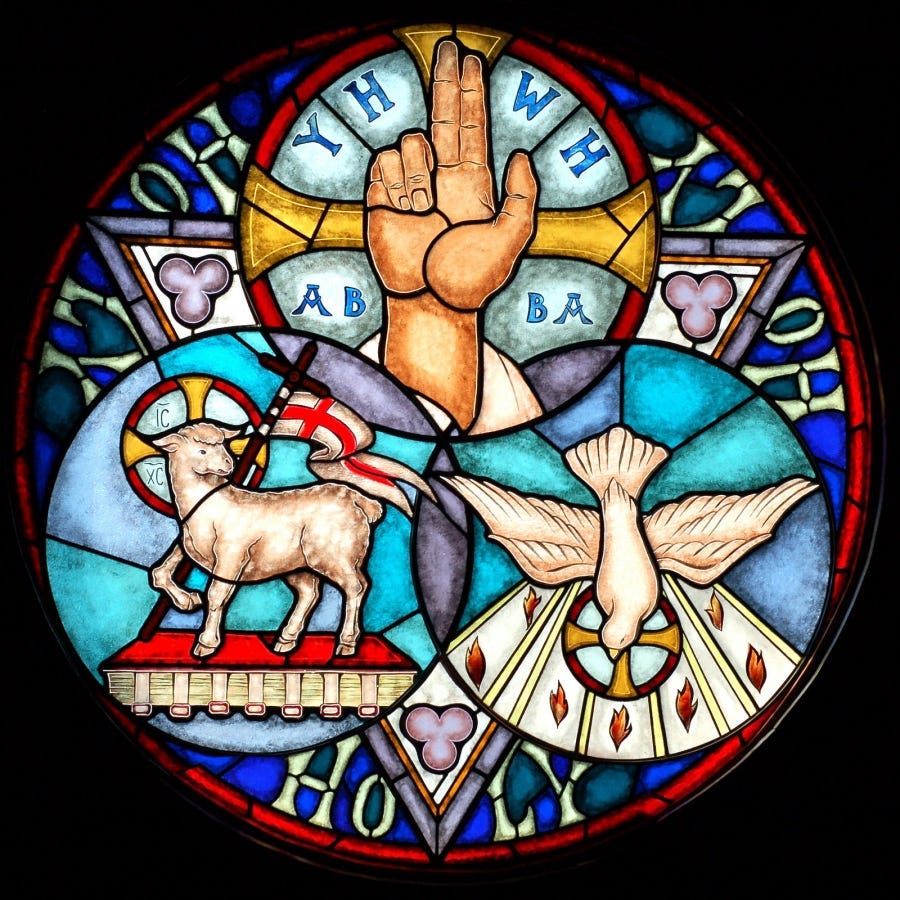
A note about fractions – this one may seem a little strange, but I’m a mathematical thinker. There are particular ideas about innate vs. taught numeracy (this is how we wound up with common core math - it’s trying to teach numeracy) and as a person with innate numeracy I don’t remember a time when I didn’t understand negative numbers and fractions, which impacts things like thinking about time, etc.
Obviously, thinking about the Trinity doesn’t require understanding fractions in the conventional mathematical sense, but it really does require the ability to hold the idea of a single whole being made up of multiple parts, and this is right around the age when that kind of fractional understanding starts to come together. Not to commit a partialist heresy (review your heresies here), but I’d argue you need to start at partialism at this age to get to the kind of sound theology that requires acceptance of doctrine rather than logic because very few second or third graders are going to simply accept the idea of God’s Triune nature just because you say so.
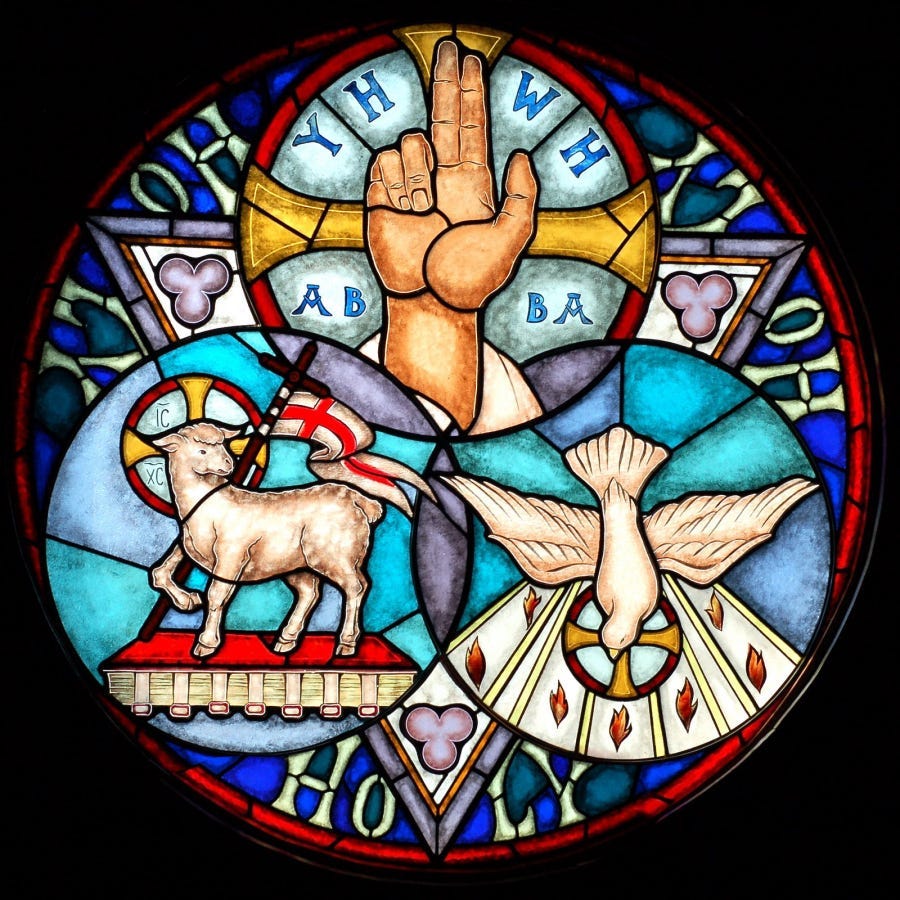
These are generalized/typical developmental milestones for this age group, of course, so they may appear unevenly, especially alongside various developmental disabilities, but this is my observation of my particular program over the last few years during which I’ve had one group grow through this phase (they were in about 2nd grade when I arrived at my parish) and another core group entering into this grappling now (finishing 2nd grade this year).
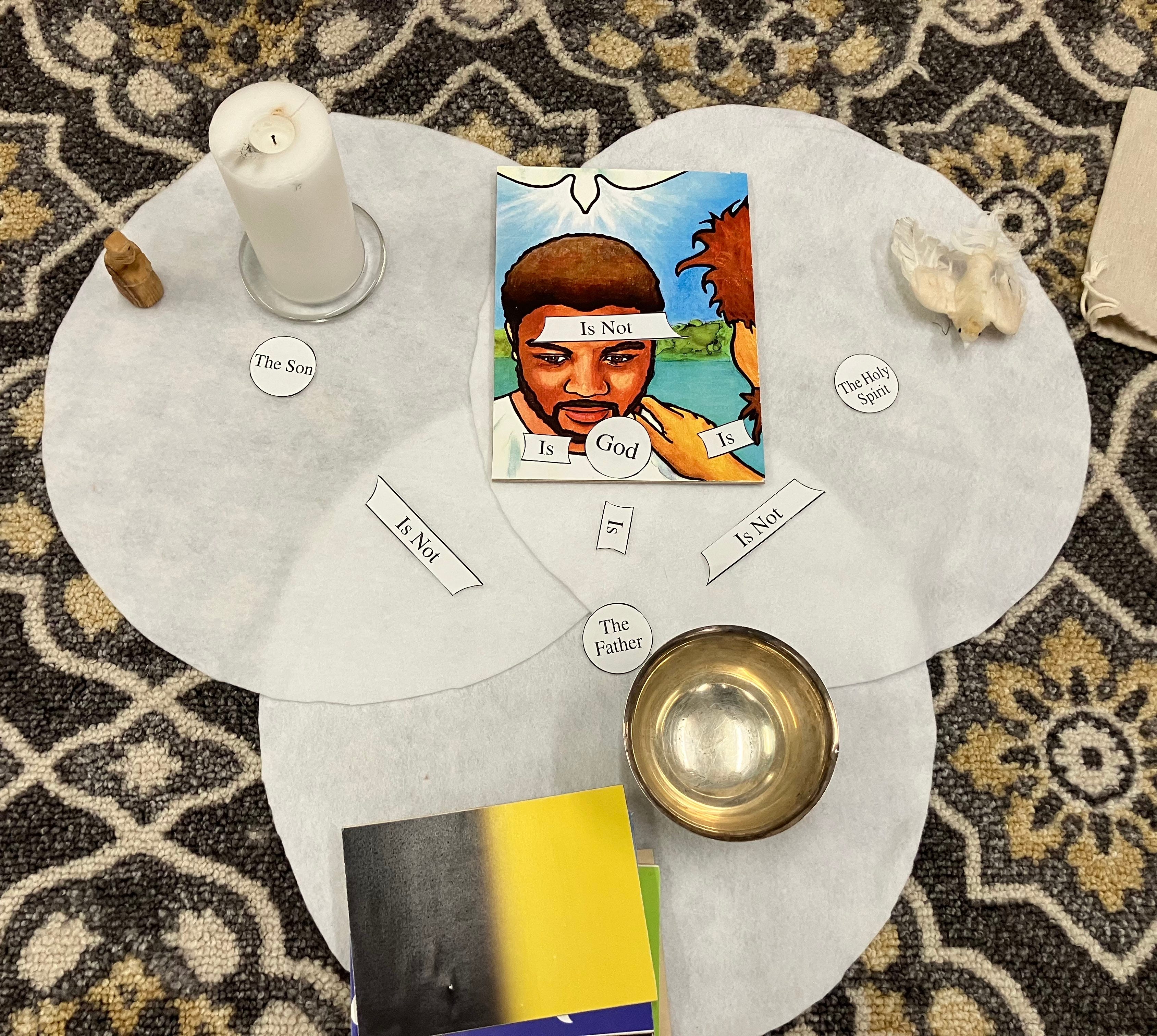
The above diagramming was done collaboratively with a 5th-7th grade group, the kids who first started grappling with this Trinity question when I arrived at my current parish and grew through those questions by coming back to them time and again and turning over different pieces of the “problem,” so to speak. Knowing that a non-negligible number of folks read this newsletter as part of thinking through their sermons, and knowing the mild dread of the Trinity Sunday sermon, I wonder what it might look like to press on the tenderness – the ways in which we all continue to circle around this idea even as we can accept the central ideas.
What if we let ourselves grow through the questions about who God is beyond and outside time, three-in-one-one-in-three, human and divine? Most of us didn't get the kind of Sunday School that let us do this work, but we’re never too old to go back to the questions.
A Note:
I’m considering slowing down my newsletter for the summer while I work on some other projects, while we all take a deep breath into a hopefully less-intensive season. My website needs updates, I have some writing projects that need work outside of this space, etc. etc. I’ll keep you good folks posted as we start finding our new rhythms here – my wife has graduated and starts her new job next week and I shift to summer hours at my main gig. I continue imagining balance!
Resource Round-Up
At the top of my list this week, for those of you who preach, even on occasion, is this very important pledge written by my dear friend the Rev. Emily Garcia. This Pledge for Preachers carefully lays out a promise not to use generative AI at any point during the sermon development process, while also delineating all those kinds of handy non-generative AI that have long supported our work (voice-to-text transcription, spellcheck, etc.). I have promised some time spent writing about the why behind this pledge – and there’s another pledge addressing formation material development forthcoming.
Godly Play training means I spend a lot of time thinking about sacred space – it’s one of our core presentations. But what makes a space sacred when we think beyond sites of communal worship? I love this post by the artist TS Bankson on the difference between a perfectly curated home and a beautiful home when it comes to the sacred.
Be lulled by this track, Benediction for Sleep by Sarah Sparks - this one is going into my paperless music rotations.
I’m really interested in checking out these Sacred Listening tools from Future of Faith. This is the stuff I like to have in my back pocket as I think about program starts and adjustments in the new year.
Let us embrace the ordinariness of ordinary time as the green growing days expand ahead of us.
Peace,
Bird